
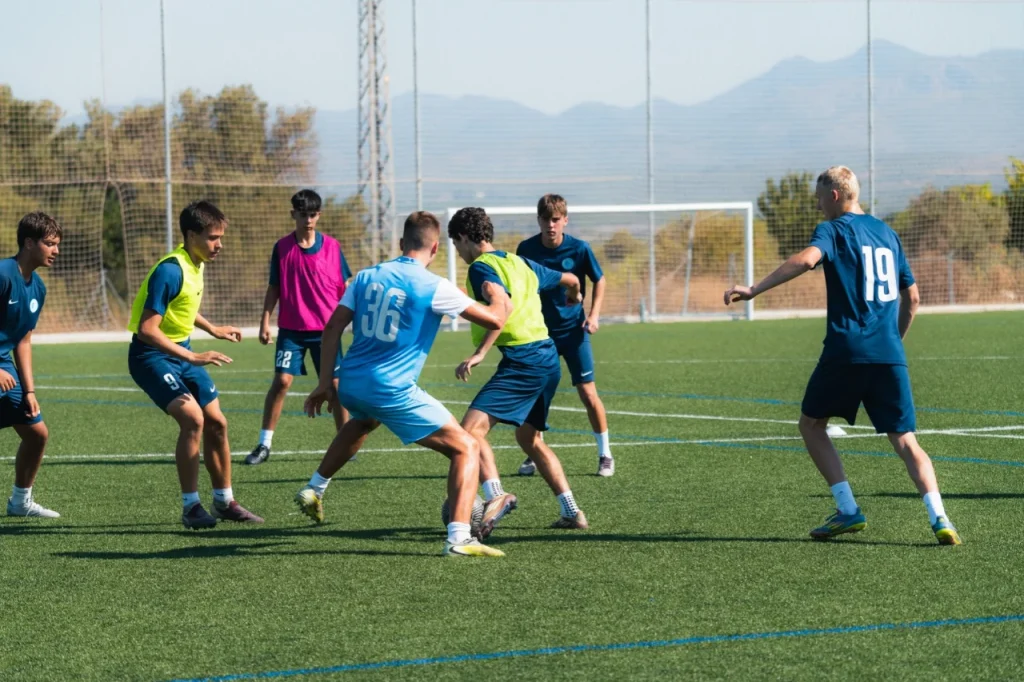
Ever found yourself facing a fast attacker, unsure whether to tackle or hold your position? You’re not alone! Defending can be one of the most challenging parts of soccer, especially when every second counts.
If you’re wondering how to be a good defender in soccer, the answer goes beyond winning tackles or being the strongest player on the field. Great defending requires positioning, anticipation, communication, and the ability to make smart decisions under pressure.
The good news? These are skills you can develop with the right training and consistent practice.
At IDA Valencia, we know that becoming a complete soccer player means developing both technical abilities and game intelligence. That’s why our approach combines professional coaching, personalized development, and competitive match experience to help young athletes improve every aspect of their game.
How to be a good defender in soccer: understanding the defensive role
Let’s start with something important: being a good defender doesn’t mean you have to win every tackle. Sometimes, preventing an attacker from moving forward or forcing them into a difficult position is just as valuable.
Defenders are responsible for protecting dangerous spaces, stopping attacking opportunities, and helping their team regain possession. But their role doesn’t end there. In modern soccer, defenders also contribute to building attacks, maintaining possession, and supporting their teammates.
According to The FA’s coaching guidance, effective defending involves delaying opponents, denying attacking opportunities, and directing attackers away from dangerous areas.
This means that knowing when to challenge an opponent is just as important as knowing when to wait.
For young players, understanding these decisions is essential. Whether you’re a center back or a fullback, your ability to read the game and react appropriately can make a significant difference to your team’s defensive organization.
What makes a good defender in soccer?
You might think the best defenders are always the fastest or strongest players. While physical qualities certainly help, they aren’t enough on their own.
The best defenders combine physical ability with tactical awareness, discipline, and good decision-making.
In fact, research shows that young soccer players can improve their tactical understanding and decision-making through structured coaching approaches. This highlights an important point: becoming a better defender isn’t just about physical ability, but also about learning to read the game and make smarter decisions under pressure.
So, what does this look like on the field? A good defender recognizes attacking threats early, communicates with teammates, and adjusts their positioning as the game develops. Rather than simply reacting to the ball, they pay attention to the opponent’s movements, available passing options, and the spaces that need protecting.
At IDA Valencia, we emphasize individual player development within a structured team environment. Our training approach helps players work on technical execution while developing the tactical understanding needed to perform in competitive situations.
What are the 5 rules of defending in soccer?
If you want to improve your defensive abilities, understanding a few fundamental principles can help you make better decisions during a match.
These five practical rules bring together key defensive concepts commonly used in soccer coaching.
| Defensive rule | What it means | How it helps your game |
| 1. Position yourself correctly | Stay between your opponent and the dangerous space | Makes it harder for attackers to progress |
| 2. Be patient | Avoid rushing into unnecessary tackles | Reduces the risk of being beaten |
| 3. Control the opponent’s direction | Guide attackers toward less dangerous areas | Limits their attacking options |
| 4. Communicate with teammates | Coordinate pressure, cover, and marking | Improves defensive organization |
| 5. React quickly to transitions | Recover your position when possession is lost | Helps prevent counterattacks |
These rules aren’t about following the same action in every situation. Good defending means recognizing which principle matters most at a particular moment.
For example, when you’re isolated against a fast winger, delaying the attack until a teammate arrives may be more useful than attempting an immediate tackle.
This combination of patience, positioning, and coordinated decision-making is central to effective team defending.
How to train to become a good defender in soccer
Understanding defensive principles is a great starting point, but improving them requires practice in realistic game situations.
The key isn’t just repeating movements. It’s learning to recognize what an opponent is doing and choosing the right response.
Positioning in front of the opponent
One of the first things every defender should learn is how to position their body during a one-on-one situation.
When approaching an attacker, avoid running straight toward them at full speed without control. Instead, slow down as you get closer, bend your knees slightly, and adopt a balanced stance that allows you to react in different directions.
Keep your eyes on the opponent’s movements and the ball while maintaining awareness of the space behind you.
A useful technique is jockeying, where you stay in front of an attacker and adjust your movements to limit their options.
A useful technique is jockeying, where you stay in front of an attacker and adjust your movements to limit their options. In fact, research on attacker–defender interactions suggests that adapting your movement to the opponent is an important part of one-on-one defending.
Remember: you don’t always need to win the ball immediately. Sometimes, controlling the attack is already a defensive success.
Successful tackles and recovery runs
Timing is everything when attempting a tackle. Challenge too early, and a skilled attacker may dribble past you. Wait too long, and they could create space to shoot or pass.
A good approach is to watch for moments when the attacker takes a heavy touch, loses control of the ball, or moves into a position where you can challenge safely.
But what happens if your opponent gets past you? That’s where recovery runs become essential. Instead of chasing directly behind the attacker, identify the most dangerous space and take a recovery angle that helps you protect the goal or reconnect with your defensive line.
Practicing these situations can improve your ability to respond when your team loses possession.
Having a good defensive mindset
Defending isn’t only physical. It also requires concentration, confidence, and emotional control.
Have you ever made a defensive mistake and struggled to stop thinking about it for the rest of the match? It happens to many young players. However, dwelling on one mistake can distract you from the next defensive action.
A strong defensive mindset means staying focused, communicating with teammates, and learning to respond constructively when something goes wrong.
At IDA, our personalized development approach gives players opportunities to receive coaching feedback and apply what they learn in competitive environments.
How can you improve your defensive skills during training?
The best way to develop as a defender is to practice situations that reflect what actually happens during matches.
For example, working on positioning without an opponent can help you understand basic movement patterns. But adding an attacker introduces the decision-making challenges you’ll face during competition.
Here are three practical training activities worth incorporating into your development.
1v1 defending drills
Practice defending against an attacker in a small area. Focus on maintaining a balanced stance, controlling distance, and guiding the opponent away from dangerous spaces.
Don’t measure success only by winning the ball. Delaying the attacker or preventing forward progress can also indicate effective defending.
2v2 defensive situations
Once you’re comfortable with individual defending, introduce a teammate.
This helps you practice communication, defensive cover, and deciding when to press or support the player applying pressure. The goal is to understand how individual decisions affect the entire defensive unit.
Recovery and transition exercises
Start with an attacking situation where possession changes unexpectedly. As soon as the ball is lost, recover into a defensive position.
These drills can help you improve your reaction to turnovers, recognize danger, and decide whether to press immediately or retreat into a more protective position.
How IDA Valencia helps young defenders develop their skills
Becoming a reliable defender takes more than occasional practice. It requires consistent training, tactical guidance, and opportunities to apply new skills against different opponents.
At IDA Valencia, we understand that every player develops at their own pace. Some need to improve their positioning, while others may benefit from working on physical preparation, confidence, or decision-making under pressure.
At IDA Valencia, our goal is to help every player develop their skills in a professional and supportive environment. As a international soccer academy, we offer a Long Term Program that combines daily training, competitive matches, academic pathways, and personalized coaching to support each player’s development both on and off the field.
Our approach also includes performance monitoring and video analysis, which can help players review their decisions and identify areas for improvement.
For defenders, this means having opportunities to work on individual technical and tactical abilities while learning to perform as part of a team.
After all, learning how to be a good defender in soccer isn’t about becoming perfect overnight. It’s about building the skills, habits, and understanding that allow you to improve over time.
If you’re looking for a high-performance environment where you can continue developing your abilities, explore our Long Term Program and discover how IDA Valencia supports young players throughout their soccer journey.
FAQ about how to be a good defender in soccer
Can you become a good soccer defender without being fast?
Yes! Speed is helpful, but positioning, anticipation, and decision-making are just as important. Reading the game effectively can help you recognize threats earlier and reduce the need to rely on recovery speed.
How do you defend against a faster soccer player?
Focus on maintaining the right distance, staying balanced, and avoiding unnecessary tackles. Try to guide the attacker away from dangerous spaces while giving your teammates time to provide defensive support.
What is the best body position for defending in soccer?
A balanced stance with slightly bent knees and your body positioned at an angle can help you react to changes in direction. Your positioning should also reflect the attacker’s movement, the location of the ball, and the space you’re protecting.
How can I improve my defensive awareness?
Practice scanning the field, watching opponents’ movements, and anticipating passing options. Reviewing match situations with a coach can also help you understand which decisions were effective and what you could improve.
How often should soccer defenders practice defensive drills?
Defensive skills should be developed consistently as part of a balanced training routine. The ideal frequency depends on your age, training schedule, physical development, and recovery needs.
What is the biggest mistake defenders make in soccer?
One common mistake is rushing into a tackle without considering the opponent’s options. Staying patient and maintaining good positioning can often be more effective than attempting to win possession immediately.